Be yourself; Everyone else is already taken.
— Oscar Wilde.
This is the first post on my new blog. I’m just getting this new blog going, so stay tuned for more. Subscribe below to get notified when I post new updates.
Be yourself; Everyone else is already taken.
— Oscar Wilde.
This is the first post on my new blog. I’m just getting this new blog going, so stay tuned for more. Subscribe below to get notified when I post new updates.
Throughout history the Nez Perce have heavily relied on trade. Prior to contact with white settlers the Nez Perce traded resources and the bounty of their land to neighboring tribes. When white settlers brought their horses the Nez Perce expanded their trade and began traveling far south. These natives traded their salmon, berries, horses and edible roots.
Today the Nez Perce no longer rely on trade as a means of economic prosperity. The Nez Perce currently have several means of income that support Native people and the area in which they reside. There are several casinos and stores owned by the tribe. The largest casino is the Clearwater Casino. Indian Country Today states it was renovated to ‘include 700 gaming machines and an event center that can accommodate 1,500 people’ (McNeel, 20017). Another source of tribal revenue is the tribal fisheries, ‘Fisheries Are the Lifeblood of the Nez Perce Economy’ (McNeel, 2013). The fisheries employ over 180 individuals. Occasionally the Nez Perce lease out their land for timber and cattle use; ‘Tribal economy has been largely based on funding from these leases and a timber program’ (Hillstrom and Hanes, n.d.). These are just a portion of what makes the Nez Perce one of the region’s largest employers.
Mcneel, Jack. (2017, April 12). 10 Things You Should Know About the Nez Perce Tribe. Indian Country Today. https://indiancountrytoday.com/archive/10-things-you-should-know-about-the-nez-perce-tribe-bFbKNrLV6kCvHNe7Eyhc7w
McNeel, Jack. (2014, December 4). Fisheries Are the Lifeblood of the Nez Perce Economy. Indian Country Today. https://indiancountrytoday.com/archive/fisheries-are-the-lifeblood-of-the-nez-perce-economy-rzUqpFJE4kSlb6iL29nHJg
Hanes, Richard & Hillstrom, Laurie. (n.d.). Nez Perce. Countries and Their Cultures. https://www.everyculture.com/multi/Le-Pa/Nez-Perc.html
Traditionally, the Nez Perce did not have a formal government prior to European contact. Before the 1840’s, the Nation consisted of 70 small communities. “Each village had a council of three or four respected men, one of whom was called chief” (Nez Perce, 2008). The chief usually had the most relatives in their community and the skills and knowledge he possessed; he would pass his title to his son. Like many other Native nations, the Chief’s main responsibility was to settle internal disputes, trade, fishing, and war .
Separate or independent villages were ran by a ‘headman’. “When a major decision was needed, the headmen and other respected people would meet in a tribal council to reach an agreement” (Nez Perce. 2008). Members of the Nez Perce were not obligated to follow the few tribal laws and rules, however, order was kept through strict social pressure.
“Nez Percé.” UXL Encyclopedia of Native American Tribes, 2nd ed., vol. 3: Arctic, Subarctic, Great Plains and Plateau, UXL, 2008. Gale eBooks, https://link-gale-com.ezproxy.spscc.edu/apps/doc/CX3048800073/GVRL?u=olym74496&sid=GVRL&xid=db405073. Accessed 9 Mar. 2020.
Nimipuutímt, commonly refereed to as just Nez Perce, is the language of the Nez Perce people. Nimipuutimt is a Sahaptian language. The language is spoken by approximately six hundred people in Idaho (Native Languages, n.d). The language ‘has been a steep decline in the number of speakers over the past decade’, (Native Voices, 2007). Like many Native Nations, language is an important aspect of Nez Perce culture. In order to protect their endangered language, the Nez Perce created a four month program in effort to revive and preserve their language. The program has been made available to tribal young people by being offered in school, in after school programs and at summer camps (Native Voices, 2007). There are also free lessons available on the tribe’s language website, https://www.nimipuutimt.org/. The Nez Perce state, ‘Learning to speak nimipuutímt is a bridge to Nez Perce culture that you can share with your family, strengthening the roots by which our language can grow’, (Nimipuutimt, n.d).
Native Voices Endowment Recipients – 2007. The Endangered Language Fund. Retrieved from http://www.endangeredlanguagefund.org/nve_2007.html
Nez Perce Language Program. Nimmipuutimt. Retrieved from https://www.nimipuutimt.org/
Nez Perce Language. Native Languages. Retrieved from http://www.native-languages.org/nez.htm
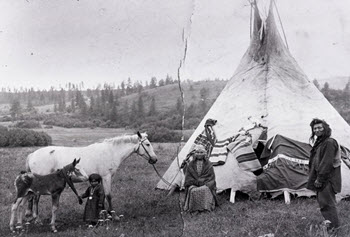
The introduction of the horse revolutionized Nez Perce culture. Equivalent to the invention of an affordably automobile for later society, many aspects of life changed for these Native people. “Before the Nez Percé acquired horses in the early 1700s, they spent most of their time fishing, hunting on foot, or gathering wild plants for food”, (UXL Dictionary, 2008). Life was a constant struggle and search to find enough food. The Nez Perce hunted small game before they depended on the horse. Hunters on foot could track a buffalo only so far. Hunting involved many in the community and took days of planning. There was little time for anything else, (American Indian, n.d.). With the horse hunters could go further and hunt the large bison. The ability to travel further and hunt larger animals more easier created more time for leisure.
Economy was directly impacted by the horse. The Nez Perce began trading to tribes further than their immediate neighbors. The Nez Perce traveled far south through the Great Plains. They became renown for their horses. The Nez Perce had the largest horse herds of any Naive group. Besides thier horse, the Pez Perce traded berris, cakes and “hunting tools for which they were famous”, (UXL Encyclopedia, 2008). Many times the Nez Perce would call for piece with there enemies for trading oppertunities.
“After the end of the Nez Perce War in the 1870s, many of the horses belonging to the Nez Perce were confiscated by the U.S. Army and sold off or killed”, (Appaloosa Meusem, n.d.). When the Nez Perce where forced onto reservations and began a lifestyle of sustenance farming they also began to interbreed there horses with working quarter hoses. This almost created a lose in the Nez Perce horse breed. In 1994, the Nez Perce officially started a breeding program to restore there iconic breed. The program uses a similar Asian horse breed to strengthen what is left of the Nez Perce Horse line. The breed is described as long and slender which lends itself well to running. The horses have a wide back and narrow chest. The horses have molted fur with a white saddle or white spots, coming in a variety of colors.
Works Cited
Impact of the Horse. A Song for the Horse Nation, Retrieved from https://americanindian.si.edu/exhibitions/horsenation/hunting.html.
Nez Percé. (2008). In UXL Encyclopedia of Native American Tribes (2nd ed., Vol. 3). Detroit, MI: UXL. Retrieved from https://link-gale-com.ezproxy.spscc.edu/apps/doc/CX3048800073/GVRL?u=olym74496&sid=GVRL&xid=db405073
The Nez Perce Horse. Retrieved from http://www.appaloosamuseum.org/the-nez-perce-horse/.
The Nez Perce have general been peaceful throughout history. The nation had close connections to neighboring tribes through trade and also with white settlers. The Nez Perce, especially Old Chief Joseph, considered the death and devastation that would occur if they stood against westward expansion and fought like many other nations. This peace and voluntary land exchanges prevented many tragedies that others experienced, until the Nez Perce Wars of 1877.
The whole of the Nez Perce did not go through a spiritual genocide or strict control policies like many other tribes, such as the Sioux. Christianity was welcomed at first as the missionaries brought education and modern technology. Some members abandoned their ancestral religion while most integrated the old and new beliefs. While the spread of Christianity to natives is not always a form of religious repression or genocide, the conversion of the Nez Perce helped solidify the attempt to whitewash and ‘americanize’ the natives.
The spread of white religion would eventually cause factionalism to occur with in the Nez Perce as traditionalist and non traditionalists. Christianity would become a major issue for these people with the loss of their culture. Several revivals occurred in attempts to bring back Nez Perce ceremonies and traditional beliefs while also ridding the land of settlers. Most of these would come and go with interest dying out in the tribe. It wouldn’t be until the 1960’s that spiritual and cultural revitalization would occur. During this era religion, language, dance and other aspects of the Nez Perce would make a comeback to celebrate tribal culture.
Hillstom, L. (n.d.) Nez Perce. Retrieved from https://www.everyculture.com/multi/Le-Pa/Nez-Perc.html.
While American settlers where expanding westward tensions with many local nations arose. The Nez Perce experienced their first contact with settlers during the Lewis and Clark Expedition. The Nation was peaceful and helped lead the travelers through the Pacific Northwest. The Nez Perce would later maintain peace and neutrality with all people while their land was being surrounded by newcomers. This helped avoid conflicts many other Native Nations experienced. In 1885,the Nez Perce signed the Walla Walla Council in which they handed over a portion of their traditional homeland in exchange for money and the promise that no more of their 13 million acres of land would be taken. Many Native groups felt betrayed when the government opened the new acquired land to white settlers. This turmoil opened the door for many wars but still the Nez Perce sought peace.
The discovery of gold in the 1860’s on Nez Perce land would create many problems for these people. Many gold seekers would ignore the Walla Walla Treaty of 1885 and search for gold on Indian land. This would result in the Nation to unsuccessfully renegotiate peacefully with the federal government. Instead, the Idaho governor collected a few signature from members of the tribe which then ceded 7 million more acres to the government. Young Chief Joseph decided to not honor the “Theft Treaty”. The government responded with a 30 day notice to vacate the area. An attack by Nez Perce rebels on whites caused a portion of the tribe to flee to Canada and started the Nez Perce War of 1877.
This portion of the Nez Perce fled 1600 miles towards Canada and fought fourteen battles in four months. The Nez Perce was always able to outsmart the better equipped military and continue moving north. During their last battle, the Indians were surrounded just 30 miles from Canada and were forced to surrender. The surrendered Nez Perce were then forced from their ancestral territory and marched to Kansas, then Oklahoma. Like many other native Nations the Nez Perce went through a diaspora and settled in unfamiliar land.
“Nez Percé.” UXL Encyclopedia of Native American Tribes, 2nd ed., vol. 3: Arctic, Subarctic, Great Plains and Plateau, UXL, 2008. Gale eBooks, https://link-gale-com.ezproxy.spscc.edu/apps/doc/CX3048800073/GVRL?u=olym74496&sid=GVRL&xid=db405073. Accessed 2 Feb. 2020.
The Nez Perce have gone by many names throughout history. Before white settlers moved to their lands and introduced the horse the Nez Perce called themselves Cuupn’itpel’uu, “we walked out of the woods” or “we walked out of the mountains”. The French named this group of people Nez Perce which mean “pierced nose”. Nose piercing was not a tradition and it is not known why they called them this. Other names included the “people of the tule” and “khouse eaters”. The Nez Perce now call themselves Nimi’ipuu, “we the people”.
The Nez Perce’s traditional lands could have been found in what is now central Idaho, northeastern Oregon, and southeastern Washington. At a time, their range also included parts of Montana and Wyoming. The Nez Perce once settled in villages along the tributaries of the Snake River. These people claim they have never migrated and have always lived in the same territory. Oral history spanning back from the Ice Age, illustrating volcanic activity and other phenomenon back their claim. In modern times, the Nez Perce can be found in Nez Percé Reservation, Idaho and Coleville Reservation, Washington.
The Nimi’ipuu trace their history back to the first humans to inhabit the earth, the Netíitelwit. Before the Netíitelwit arrived the world was filled with powerful mythic beings. The arrival of these first humans brought an end to these entities and marked the dawn of normal man. A myth is told among the Nez Perce that an extremely powerful being was slayed in order to clear a way for the emergence of the Netíitelwit. The severed parts of this being mark important cultural landmarks throughout the area for the Nez Perce. The mythic origins place the emergence of the first humans on the Clearwater River in Idaho.
The Nez Perce are one of two Sahaptian-speaking peoples, the other are the Sahaptin. They are culturally similar to other groups in the area such as the Yakima, Klickatat and Walla Walla. Traditionally, they traveled around each season to hunt, fish, and gather. Interestingly, when the horse was introduced the culture to the Nez Perce completely changed. They became traders and traveled as far as the Great Plains to hunt buffalo. The Nez Perce had more horses than any other native group. They bred a breed of distinguished horse known to be extremely sturdy. Theses spotted horses are known as Appaloosas.
Nez Percé. (2008). In UXL Encyclopedia of Native American Tribes. (Vol. 3)
Nez Perce Religious Traditions. In Encyclopedia of Religion. ( Vol. 2, pp. 6595-6596)
This is an example post, originally published as part of Blogging University. Enroll in one of our ten programs, and start your blog right.
You’re going to publish a post today. Don’t worry about how your blog looks. Don’t worry if you haven’t given it a name yet, or you’re feeling overwhelmed. Just click the “New Post” button, and tell us why you’re here.
Why do this?
The post can be short or long, a personal intro to your life or a bloggy mission statement, a manifesto for the future or a simple outline of your the types of things you hope to publish.
To help you get started, here are a few questions:
You’re not locked into any of this; one of the wonderful things about blogs is how they constantly evolve as we learn, grow, and interact with one another — but it’s good to know where and why you started, and articulating your goals may just give you a few other post ideas.
Can’t think how to get started? Just write the first thing that pops into your head. Anne Lamott, author of a book on writing we love, says that you need to give yourself permission to write a “crappy first draft”. Anne makes a great point — just start writing, and worry about editing it later.
When you’re ready to publish, give your post three to five tags that describe your blog’s focus — writing, photography, fiction, parenting, food, cars, movies, sports, whatever. These tags will help others who care about your topics find you in the Reader. Make sure one of the tags is “zerotohero,” so other new bloggers can find you, too.
Have a WordPress.com account? Log in now.

